
Views: 0 Author: Site Editor Publish Time: 2026-11-24 Origin: Site


Struggling to reach ultra-low temperatures efficiently? Picture this scenario on your plant floor. It is the middle of a high-yield production run, and your blast freezer begins to lag. The temperature difference between the evaporator and condenser widens. This creates a massive compression ratio. Suddenly, your single-stage systems overheat. Safety lockouts trigger, halting production entirely. This disrupts the cooling process and drastically increases operational costs through wasted electricity and emergency maintenance.
As industrial processes push for deeper freezes, standard refrigeration cycles simply cannot handle the thermal load. Efficiency drops. Mechanical wear accelerates. This comprehensive guide explores the mechanics of multi-stage compression. It illustrates exactly why upgrading your infrastructure is the ultimate engineering fix for heavy-duty cooling challenges.
Efficiency at Low Temperatures: Implementing a two-stage compression cycle significantly improves the Coefficient of Performance when evaporating temperatures drop below -30 degrees Celsius. This directly shrinks your facility's electrical footprint.
Equipment Protection: Utilizing an intercooler between the compression stages prevents dangerous discharge temperature spikes. This thermal control protects internal components from mechanical stress and extends the overall lifespan of the compressor.
Cost Savings: The initial capital expenditure for multi-stage equipment is higher. However, long-term energy savings and drastically reduced maintenance interventions make it a highly cost-effective solution for industrial operators.
Versatility: Modern skid-mounted units offer customizable, plug-and-play solutions. They integrate seamlessly into complex infrastructures, including food processing plants, petrochemical facilities, and large-scale cold storage warehouses.
To understand the necessity of multi-stage refrigeration, we must examine the thermodynamic limits of standard single-stage cooling cycles. Single-stage systems are engineered to handle moderate temperature differences between the evaporator and the condenser. When industrial processes demand ultra-low temperatures, this standard cycle encounters severe mechanical and thermodynamic bottlenecks.
The core metric in refrigeration mechanics is the compression ratio. This represents the absolute discharge pressure divided by the absolute suction pressure. As the required evaporating temperature decreases, the suction pressure drops significantly. Conversely, if ambient temperatures are high during the summer months, the condensing pressure rises. This widening gap creates a massive compression ratio.
When the pressure difference between the suction and discharge sides becomes too large, the compressor's volumetric efficiency plummets. Volumetric efficiency refers to the actual volume of refrigerant gas the compressor can pump compared to its theoretical displacement. In high-ratio scenarios, the high-pressure gas remaining in the clearance volume of the compressor re-expands as the intake cycle begins. Consequently, the compressor works continuously at maximum load. It consumes vast amounts of electricity yet pumps an insufficient volume of refrigerant to maintain the required cooling capacity.
Beyond inefficiencies, forcing a single-stage compressor to operate at high compression ratios introduces severe physical risks to the equipment. The temperature of the discharged refrigerant gas is directly proportional to the compression ratio. When this ratio exceeds the compressor's design limits, discharge temperatures can easily surpass 150 degrees Celsius.
At these extreme temperatures, the unmistakable smell of burnt oil often precedes catastrophic failure. The chemical stability of the compressor's lubricating oil is compromised. It loses its viscosity and fails to provide an adequate hydrodynamic film between moving metal parts. This leads to accelerated mechanical wear on bearings and rotors. Furthermore, the extreme heat causes the oil to carbonize. This forms damaging sludge and hard deposits on internal valves. Ultimately, forcing a single-stage unit to perform a two-stage job is a well-documented recipe for high utility bills and frequent maintenance emergencies.
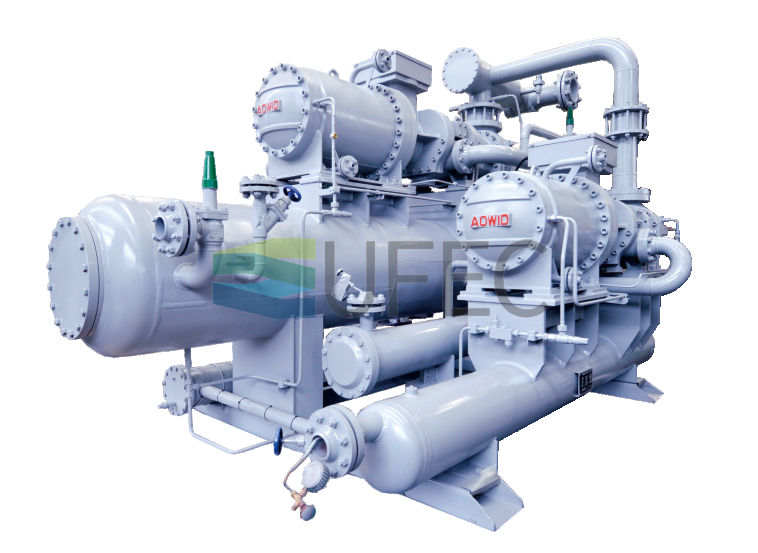
To bypass the limitations of single-stage cycles, mechanical engineers utilize multi-stage compression. A specialized double-stage screw refrigeration compressor unit is an industrial cooling system designed to divide the total required compression work into two distinct steps. Splitting the workload significantly reduces both mechanical and thermal strain on the equipment.
Specifically, this architecture combines a low-pressure stage and a high-pressure stage into one synchronized operation. Depending on the specific design, this is achieved by housing two sets of compression rotors within a single robust casing or by utilizing two separate but connected compressors operating in tandem.
Screw compressors are particularly well-suited for this industrial application. Reciprocating compressors rely on a complex arrangement of fragile suction and discharge valves. In contrast, screw compressors utilize twin meshing helical rotors. This rotary mechanism ensures a continuous, pulsation-free flow of refrigerant gas. In addition, they possess fewer moving parts subject to mechanical wear and are significantly more resilient against liquid slugging, which is a common hazard in deep-freeze applications.
The operational efficiency of a two-stage system lies in its thermodynamic manipulation of the refrigerant gas. Breaking the compression process into manageable phases maintains optimal pressures and temperatures. Here is a step-by-step breakdown of how the refrigerant travels through the cycle.
The cycle begins at the evaporator. The refrigerant absorbs heat from the industrial process and vaporizes at a very low temperature and pressure. This low-pressure vapor is drawn into the first stage of the compressor, commonly referred to as the booster stage. Here, the twin rotors compress the gas, elevating its pressure to an intermediate level. Because the compression ratio in this single step is kept relatively low, the volumetric efficiency remains high, and the temperature of the gas increases only moderately.
The defining feature of a two-stage system is the intercooling phase. The intermediate-pressure gas exiting the booster stage is still too warm to be efficiently compressed again. Before it enters the second stage, it is directed through an intercooler or economizer.
In this vessel, a small amount of liquid refrigerant from the condenser is injected and expanded. As this liquid evaporates, it absorbs heat from the intermediate-pressure gas, effectively desuperheating it. This intermediate cooling step is the secret weapon of the cycle. Lowering the temperature and specific volume of the gas drastically reduces the amount of mechanical work the second-stage rotors must perform.
Once the gas has been cooled to an optimal temperature, it is drawn into the high-pressure stage of the compressor. The rotors compress this cooler, denser gas from the intermediate pressure up to the final condensing pressure required to reject heat into the environment. Because the gas entered this stage at a reduced temperature, the final discharge temperature remains safely within the operational limits of the compressor's lubricating oil and mechanical seals.
Transitioning from a single-stage system to a two-stage configuration requires a higher initial investment. However, the operational advantages are substantial, measurable, and yield a rapid return on investment.
The Coefficient of Performance dictates the ratio of useful cooling provided to the electrical energy consumed. In ultra-low temperature applications, a two-stage system offers a significantly higher Coefficient of Performance than a single-stage equivalent. Breaking the compression into two smaller steps and cooling the gas in between drastically reduces the total power consumption required by the compressor motor. Imagine a facility manager watching the daily power draw drop by 20 to 30 percent. The energy saved over months of continuous industrial operation quickly offsets the initial equipment costs.
Heat is the primary enemy of mechanical refrigeration equipment. Utilizing the intercooling process allows double-stage units to maintain safe discharge temperatures regardless of how low the evaporating temperature drops. This thermal control protects the internal rotors, prevents the degradation of mechanical seals, and maintains the chemical integrity of the compressor oil. The result is a more reliable system with fewer unexpected breakdowns and substantially lower long-term maintenance costs.
The intercooler in a two-stage system does more than just cool the intermediate gas. It also subcools the liquid refrigerant traveling from the condenser to the main evaporator. Subcooled liquid possesses a lower enthalpy, meaning it has a greater capacity to absorb heat once it reaches the evaporator. This increases the net refrigeration effect per pound of refrigerant pumped. It allows the system to achieve target temperatures faster and maintain them more consistently during heavy product loading.
Industrial facilities often face fluctuating ambient temperatures and highly variable product loads. A double-stage screw unit provides exceptional operational stability under these extreme conditions. Dividing the total compression ratio ensures that sudden spikes in ambient heat do not push the system into overload or trigger high-pressure safety lockouts. This guarantees uninterrupted facility operation.
When analyzing recent industry trends surrounding refrigeration architecture, several macroeconomic and regulatory factors drive the shift toward two-stage compression. The global supply chain is experiencing a massive surge in demand for deep-freeze capabilities. From the rapid distribution of temperature-sensitive pharmaceuticals to the booming market for premium frozen seafood, the cold chain is being pushed to its thermodynamic limits.
Furthermore, stringent environmental regulations are forcing facilities to phase out legacy refrigerants that have a high Global Warming Potential. Modern eco-friendly alternative refrigerants exhibit different thermodynamic properties. Many of these sustainable refrigerants result in much higher discharge temperatures when compressed. To safely utilize these refrigerants in low-temperature applications without destroying equipment, engineers are abandoning single-stage setups.
In contrast to outdated cooling methods, upgrading to a modern Open-Type Skid Double-Stage Screw Refrigeration Compressor Unit aligns perfectly with contemporary sustainability goals. It allows facilities to meet strict environmental compliance standards while simultaneously curbing skyrocketing industrial electricity costs. As energy prices continue to be volatile globally, the shift toward multi-stage compression is no longer just a mechanical preference. It is a strategic business necessity for future-proofing industrial operations.
Selecting the correct refrigeration architecture depends heavily on the specific thermal requirements of your facility. Below is an objective comparison framework to assist in the engineering decision-making process.
Feature | Single-Stage Compressor | Double-Stage Screw Compressor Unit |
|---|---|---|
Best Temperature Range | Above -20 degrees Celsius | Below -30 degrees Celsius down to -60 degrees Celsius |
Initial Capital Investment | Lower baseline equipment and installation costs. | Higher upfront cost due to dual compression stages and intercooling vessels. |
Energy Efficiency at Low Temps | Poor. Coefficient of Performance drops sharply as compression ratios increase. | Excellent. Intercooling reduces the thermodynamic work required, drastically improving efficiency. |
Discharge Temperatures | Dangerously high at low evaporating temperatures, risking oil carbonization. | Strictly controlled and maintained within safe limits due to intermediate gas cooling. |
System Complexity | Simple piping, fewer vessels, and straightforward control logic. | Advanced. Requires economizers, complex oil management, and intelligent controls. |
Compressor Lifespan | Shortened significantly if forced to operate in ultra-low temperature ranges. | Extended, as thermal and mechanical stresses are distributed across two stages. |
Selecting the right equipment does not have to be a convoluted process. The standard engineering metric is straightforward. If your required evaporating temperature falls below -30 degrees Celsius, or if your calculated compression ratio consistently exceeds 10 to 1, a single-stage system is no longer viable. For facilities crossing these operational thresholds, transitioning to a specialized double-stage screw refrigeration compressor unit guarantees that your infrastructure can handle the thermal load without facing catastrophic mechanical failures.
Heavy-duty multi-stage cooling systems are not just optional enhancements. They are non-negotiable requirements in sectors where precise ultra-low temperatures are directly tied to product quality, safety compliance, and production throughput.
In the industrial food sector, the speed at which a product freezes determines its final quality upon thawing. Blast freezing and Individually Quick Frozen applications require ambient air temperatures of -35 to -45 degrees Celsius to rapidly drop the core temperature of meats, seafood, and prepared meals.
If the freezing process is too slow, large ice crystals form within the cellular structure of the food. These crystals puncture cell walls, leading to moisture loss, texture degradation, and nutrient depletion. A two-stage system provides the massive refrigeration capacity required to achieve these rapid freezing curves. Maintaining stable ultra-low evaporating temperatures ensures that cellular integrity is preserved. This allows food processors to maximize their daily production yields without sacrificing quality.
The chemical and pharmaceutical industries rely on exact thermal management to control volatile reactions and preserve sensitive biological compounds. In petrochemical refining, many polymerization reactions release massive amounts of heat. Removing this heat rapidly is critical to preventing runaway reactions. Two-stage screw compressors provide the reliable, high-capacity cooling necessary to chill reactor jackets and condense volatile organic compounds at temperatures well below -30 degrees Celsius.
Similarly, the storage and processing of blood plasma, active pharmaceutical ingredients, and certain vaccines require strict adherence to ultra-low temperature protocols. A temperature deviation of even a few degrees can ruin a multi-million-dollar batch. The operational stability provided by two-stage compression ensures these critical environments remain perfectly regulated.
Modern cold chain logistics rely on massive refrigerated warehouses to store thousands of tons of frozen goods year-round. These facilities experience constant thermal load fluctuations due to product movement, forklift traffic, and bay door openings. Maintaining a consistent -25 to -30 degrees Celsius room temperature across a facility spanning hundreds of thousands of square feet requires immense refrigeration power.
Using single-stage compressors for this application would result in exorbitant electricity bills due to poor low-temperature efficiency. Utilizing two-stage compression significantly improves the system's efficiency. The reduction in specific power consumption translates to hundreds of thousands of dollars in energy savings over the equipment's lifespan.
Once the decision has been made to upgrade, the focus must shift to selecting the specific design architecture that best suits your facility's operational layout. Prioritizing an Open-Type Skid Double-Stage Screw Refrigeration Compressor Unit ensures that your facility benefits from isolated motor heat, streamlined installation, and intelligent system management.
One of the most critical design choices is the configuration of the compressor motor. In semi-hermetic designs, the electric motor is enclosed within the same casing as the compressor. It relies on the cold suction gas returning from the evaporator to cool the motor windings. At -40 degrees Celsius, the suction gas is extremely thin and lacks the thermal capacity to adequately cool the motor, leading to frequent motor burnouts. Furthermore, the heat generated by the motor is absorbed by the refrigerant, reducing the net cooling capacity.
Specifically, an open-type design solves this problem entirely. The electric motor is mounted externally and connected to the compressor via a precision-aligned coupling. Because the motor is cooled by ambient air rather than refrigerant, no motor heat enters the refrigeration cycle. This maximizes the system's cooling capacity and makes motor maintenance significantly easier. Technicians do not need to evacuate the refrigerant charge to access electrical components.
Industrial refrigeration systems are inherently complex. They require precise piping between the low-stage compressor, the intercooler, the high-stage compressor, and the oil management system. Constructing this piping on-site is time-consuming, labor-intensive, and susceptible to welding errors.
Skid-mounted units eliminate these risks. The entire two-stage system is pre-engineered, assembled, piped, and wired on a robust structural steel base at the manufacturing facility. This plug-and-play approach means the unit arrives ready for immediate integration. Factory assembly ensures that all piping adheres to strict specifications. The entire package undergoes rigorous pressure testing before shipment. This drastically reduces on-site installation time and minimizes labor costs.
A two-stage refrigeration cycle requires precise synchronization. Therefore, the quality of the control system is just as important as the mechanical hardware. When selecting a unit, ensure it is equipped with an intelligent Programmable Logic Controller panel.
The control system must feature advanced algorithms capable of automatically adjusting the compressor's slide valves to match fluctuating thermal loads. Furthermore, it must provide real-time monitoring of critical parameters, including intermediate pressure, oil differential pressure, discharge temperatures, and motor amperage. Comprehensive fault logging and data integration are essential features for modern maintenance programs.
When temperatures drop, compression ratios inevitably rise. Attempting to force standard equipment to handle extreme thermal loads is a losing battle against physics. This makes two-stage compression an absolute necessity for any facility serious about efficiency, safety, and long-term profitability.
Implementing intercooling and dividing the mechanical workload ensures your infrastructure operates smoothly without the constant threat of overheating or lubrication failure. Investing in this equipment transforms a struggling, energy-draining refrigeration cycle into a highly optimized industrial cooling operation.
Do not let outdated technology bottleneck your production capabilities. Upgrade your facility's cooling infrastructure today. Explore the robust, customizable solutions at UFECTECH to find the exact industrial refrigeration equipment tailored to your deep-freeze requirements.
Generally, if your industrial application requires evaporating temperatures below -30 degrees Celsius, a double-stage unit is highly recommended. If your system's calculated compression ratio exceeds 10 to 1, relying on a single-stage compressor becomes mechanically unsafe and highly inefficient. Two-stage systems are specifically engineered to handle these extreme parameters, ensuring both energy efficiency and long-term equipment safety.
The intercooler acts as the thermodynamic bridge between the two compression stages. It cools the superheated refrigerant gas discharged from the first stage before it enters the second stage. This critical cooling process prevents the final discharge temperature from exceeding safe limits, thereby protecting the compressor's lubricating oil from thermal breakdown. Additionally, cooling the gas reduces its specific volume, which significantly lowers the mechanical work required by the second-stage compressor.
No, it is significantly cheaper to run in ultra-low temperature applications. While the initial capital expenditure for purchasing and installing a two-stage system is higher than that of a single-stage system, the operational economics heavily favor the two-stage design. By drastically improving the Coefficient of Performance at low temperatures, the unit consumes far less electricity per ton of refrigeration. These massive energy savings quickly offset the upfront investment.
While it is technically possible to retrofit an existing system by adding a separate booster compressor, an intercooler, and complex field piping, it is rarely the most practical or economical choice. Field retrofits are prone to engineering errors, space constraints, and control logic synchronization issues. It is much more efficient, reliable, and space-saving to install a purpose-built, factory-engineered double-stage unit.
A two-stage compressor saves energy by dividing the total compression ratio into two smaller steps and cooling the refrigerant gas between these stages. Because the gas entering the second stage is cooler and denser, the high-pressure compressor requires significantly less electrical power to push the refrigerant to the final condensing pressure. This thermodynamic optimization drastically reduces the total amperage draw of the system.
A compound two-stage compressor houses both the low-pressure and high-pressure compression rotors within a single physical casing, driven by a single motor. In contrast, a booster system utilizes two entirely separate compressors, each with its own motor, connected in series via piping. Compound units are highly compact and space-saving, while separate booster systems offer greater flexibility for massive industrial plants with highly variable loads.
