
Views: 0 Author: Site Editor Publish Time: 2026-11-24 Origin: Site


Food processing facilities face a constant, complex challenge. They must freeze large volumes of perishable products quickly. Doing this without sacrificing cellular quality, compromising food safety, or exhausting valuable floor space is notoriously difficult. As production demands scale, facility managers are forced to evaluate their thermal processing capabilities. Traditional freezing methods often cause severe cellular damage due to slow freezing rates. Compounding the issue, these outdated systems incur high energy costs. They also require massive spatial footprints that inevitably bottleneck entire production lines.
The optimal solution for modern food processing is the Spiral Quick Freezing Machine. It has firmly established itself as the industry standard for high-efficiency, continuous thermal exchange. By utilizing a vertical configuration, this equipment fundamentally changes spatial planning and product flow. This comprehensive guide breaks down the exact science behind the freezing process. We will cover core operational benefits, preventative maintenance best practices, and how to rigorously choose the right system tailored to your specific production needs.
Key Takeaways
To truly optimize a food processing line, stakeholders must first grasp the fundamental mechanics and terminology associated with industrial refrigeration equipment. Understanding the baseline engineering helps clarify why vertical integration is so highly valued in modern manufacturing.
Historically, the food processing sector relied heavily on slow, bulky blast freezers or sprawling linear tunnel freezers. Blast freezers were functional for batch processing but demanded extensive manual labor to load and unload carts. Their inherently slow rate of heat removal often degraded the cellular structure of the food. Tunnel freezers eventually introduced continuous processing. However, they demanded immense stretches of linear floor space, making them highly impractical for facilities with limited square footage.
Specifically, recent industry analysis reveals a decisive shift in thermal processing trends. Driven by surging industrial real estate costs and stricter global food safety mandates, plant operators are moving away from traditional horizontal expansion. Today's market demands compact, highly automated systems that integrate seamlessly with downstream packaging. There is also a growing emphasis on sustainability. Modern processors actively seek refrigeration equipment compatible with low global warming potential refrigerants and equipped with smart energy-saving drives. This industry-wide pivot makes space-saving vertical freezing technology not just a preference, but an operational necessity.
Understanding the anatomy of the machine is essential for operators and procurement teams alike. A spiral freezer operates as a highly synchronized system of mechanical and thermodynamic components.
The continuous conveyor belt acts as the vital artery of the machine. Constructed from food-grade SUS304 stainless steel mesh or modular plastic, it transports the product seamlessly from the loading zone to the discharge portal. Supporting this movement is the rotating drum. This central cylindrical drive mechanism propels the belt upward or downward in a continuous spiral motion using low-tension overdrive technology to minimize friction.
Temperature control is handled by heavy-duty evaporators. These industrial heat exchangers absorb thermal energy from the internal environment using advanced refrigerants. Working in tandem with the coils are high-efficiency fans. These industrial-grade blowers force chilled air across the evaporator coils and directly onto the food products at high velocities. Finally, an insulated enclosure built from thick polyurethane panels clad in stainless steel seals the entire system to prevent thermal leaks and maintain the extreme sub-zero environment.
Demystifying the internal mechanics reveals exactly how this equipment achieves rapid temperature reduction without damaging delicate food items. It is a masterclass in controlled thermodynamics.
The journey of a food product through the system follows a highly controlled mechanical pathway. Imagine a line of freshly formed, warm pastries entering the freezer through an insulated infeed portal. They immediately transfer onto the spiraling belt. As the belt travels along the rotating drum, the pastries face a harsh, sub-zero environment typically hovering around -35°C to -40°C.
The specific retention time is meticulously calibrated. Engineers adjust this duration based on the item's thickness, density, and moisture content. A thin fish fillet may require only 15 minutes of retention. In contrast, dense, marinated poultry cuts might require well over an hour. By the time the product reaches the outfeed portal, its core temperature has been successfully reduced to the target standard, ensuring it exits fully frozen and ready for immediate packaging.
The true science behind the process lies in advanced airflow management. Targeted, high-velocity cold air directs horizontally or vertically across the tiers of the spiral belt. This rapidly strips latent heat away from the product. Such rapid thermal exchange forms the foundation of Individual Quick Freezing.
In slow freezing scenarios, large, jagged ice crystals form within the food. These crystals puncture delicate cell walls, causing severe moisture loss and a mushy texture upon thawing. By utilizing an IQF Spiral Quick Freezing Machine, the rapid thermodynamic heat removal forces water molecules to form microscopic ice crystals instead. This crucial scientific mechanism prevents cellular damage. It effectively protects the structural integrity, original texture, and nutritional profile of the food.
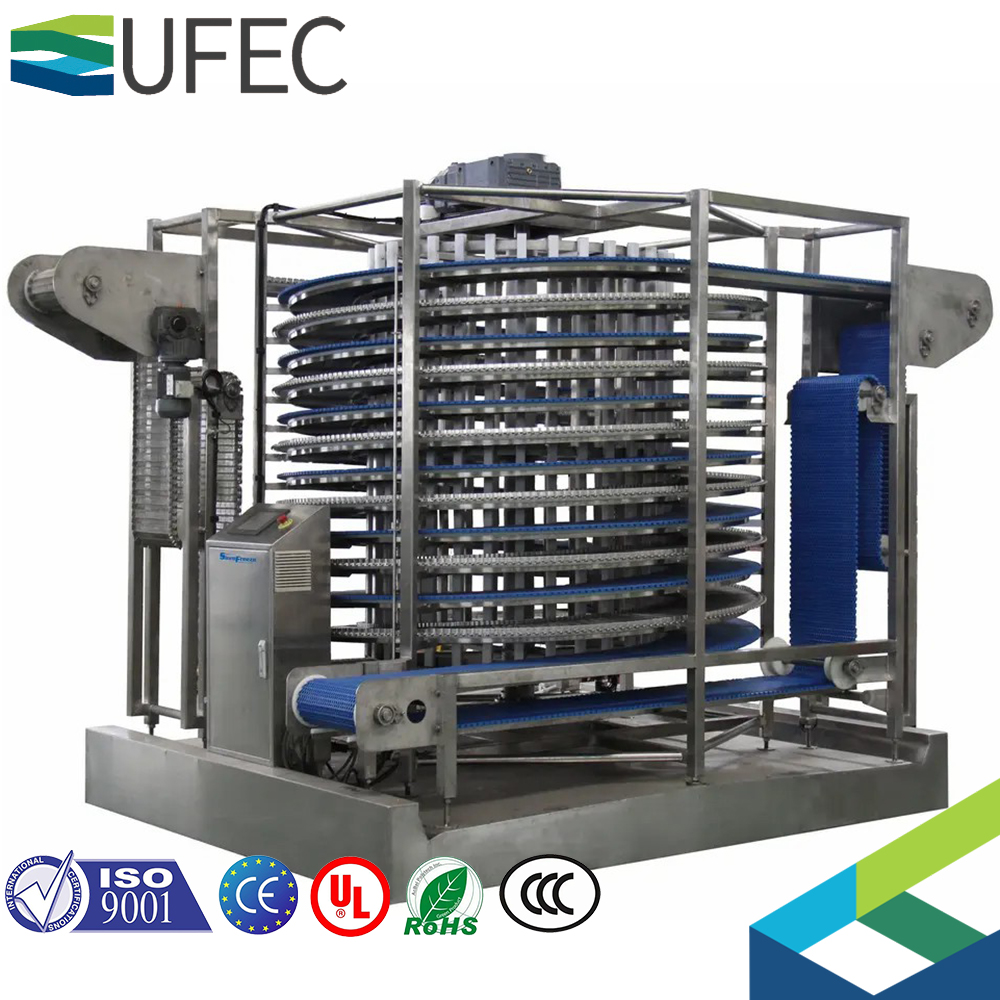
For plant managers and financial decision-makers, investing in advanced refrigeration technology must yield a measurable return on investment. The benefits extend far beyond simply making food cold.
Industrial real estate is a premium commodity. Current market trends show that supply chain pressures and soaring construction costs force processors to maximize their existing facility layouts rather than breaking ground on new buildings. Linear tunnel freezers require vast stretches of continuous floor space. This severely limits a facility's ability to install downstream packaging equipment.
Furthermore, spiraling the conveyor belt vertically allows hundreds of meters of active freezing belt to fit into a footprint as small as 15 to 20 square meters. This vertical design transforms previously unused overhead space into highly productive freezing zones. Facilities can drastically increase their throughput without requiring expensive structural expansions.
Product yield directly impacts a processor's bottom line. Older freezing methods subject food to harsh handling and prolonged exposure to dry air, resulting in severe dehydration. When moisture evaporates from a breaded chicken tender before it fully freezes, the manufacturer loses sellable weight. This loss can reach up to 5 percent per batch.
The gentle mechanical handling of the continuous belt prevents physical damage to delicate items. More importantly, the rapid Individual Quick Freezing process locks in moisture immediately. This reduces dehydration to less than 1 percent. By minimizing moisture loss during the thermal cycle, processors maintain a higher final product weight. The direct result is a better-looking, better-tasting end product that commands a premium market value.
Batch processing is inherently inefficient. It creates a frustrating stop-and-go production flow where upstream cooking lines must pause while the blast freezer completes its slow cycle. Continuous freezing eliminates these delays entirely. Products flow seamlessly from the preparation line directly into the freezer without human intervention. This automated transition streamlines the entire factory floor, significantly reducing manual labor costs and eliminating bottlenecks that cap daily production capacities.
Educating yourself on the different structural designs available in the market is crucial for narrowing down the right choice. Facilities must weigh spatial constraints against target product types to ensure optimal performance.
| Feature | Linear Tunnel Freezer | Spiral Quick Freezing Machine |
|---|---|---|
| Operational Footprint | Requires massive horizontal floor space | Highly compact vertical design |
| Retention Time Flexibility | Limited by the physical length of the tunnel | Highly adjustable via variable speed drives |
| Ideal Application | Thin products requiring very fast freezing | Versatile processing for meat, bakery, and seafood |
In addition to choosing the general machine type, operators must select the right internal framework. Traditional systems utilize a large, central rotating drum to support and drive the conveyor belt. The belt is guided by a stationary framework of resting rails. These systems are mechanically robust and capable of handling extremely heavy product loads like bulk beef. However, the internal framework creates multiple crevices requiring rigorous cleaning protocols.
Self-stacking technology represents a significant leap in sanitary engineering. In this design, the central driving drum and stationary support rails are completely eliminated. The conveyor belt features specialized, interlocking side links. As the belt spirals upward, each tier rests directly on the side links of the tier below it. The elimination of stationary rails removes primary areas where food debris accumulates, vastly improving hygiene and simplifying sanitation.
Installing the equipment is only the first step. Operating it efficiently day in and day out is what determines long-term profitability. Operators must implement actionable strategies to control utility costs and manage frost.
Industrial refrigeration accounts for a massive portion of a facility's energy expenditure. Driven by corporate sustainability goals, modern plants are adopting smart technologies to curb power usage. Operators should utilize variable frequency drives to adjust fan speeds dynamically based on the specific product load.
Running circulation fans at maximum speed for lightweight products like baked goods wastes enormous amounts of electricity. Because fan energy consumption follows affinity laws, even a 20 percent reduction in fan speed cuts electrical power usage nearly in half. Additionally, managing the thermal load by ensuring products enter the freezer at the lowest possible ambient temperature drastically reduces compressor workload.
Frost buildup is the ultimate enemy of thermal efficiency. As moisture from warm food and ambient air enters the chamber, it freezes instantly onto the cold evaporator coils. This frost acts as an insulating blanket, severely reducing the coil's ability to pull heat from the air.
Historically, removing this ice required shutting down the entire production line for an extended thaw. Today, advanced sequential defrosting systems mitigate this operational nightmare. These systems use targeted, high-pressure blasts of compressed air to knock frost off the coils dynamically while the machine continues to run. By managing frost continuously, facilities can extend their production runs from a single shift to well over a hundred hours before requiring a full thermal shutdown.
Addressing the operational pain point of unexpected downtime requires a strict, proactive maintenance framework rather than a reactive repair strategy. A broken freezer full of thawing product is a costly disaster.
Routine inspections are the absolute foundation of equipment longevity. Operators must adhere to strict schedules based on empirical equipment data.
Daily checks should include visually monitoring the evaporator coils for abnormal ice accumulation. Technicians must ensure all safety sensors, such as belt flip detectors and door seals, are clean and fully functional.
Weekly maintenance requires a more hands-on approach. Maintenance teams must inspect the conveyor belt tension to prevent jumping or snapping. They should apply food-grade lubricants to the main drive chain, bearings, and gearboxes to minimize mechanical wear. Finally, examining the plastic wear strips on the supporting rails for excessive friction degradation prevents catastrophic belt failures.
Even meticulously maintained systems can experience operational hiccups. When anomalies occur, swift diagnostic action is required. If the belt begins jamming or flipping, operators should immediately check for ice buildup on the drive sprockets. Verifying that upstream workers are loading products evenly across the belt width is also critical.
If uneven freezing occurs, it is typically a symptom of blocked airflow. Technicians should inspect fan outputs for electrical failure and ensure the evaporator coils are not choked with ice. Excessive frost on the internal panels often indicates that the infeed or outfeed portals are allowing too much humid factory air into the enclosure. This signals a critical need to adjust the air balance baffles.
Selecting industrial freezing equipment is a capital-intensive decision. It requires careful calculation of production metrics, spatial availability, and long-term business goals to ensure a seamless integration.
When it comes to industrial refrigeration, bigger is not inherently better. Businesses must accurately match the machine's capacity to their actual upstream throughput. Installing a massive, high-capacity system for a modest production line results in wasted electricity and inefficient airflow. Conversely, an undersized machine causes severe bottlenecks and fails to reach target core temperatures.
For mid-sized meat processing operations, specialty bakeries, or pilot production lines, investing in a Small Capacity 200kg IQF Spiral Quick Freezing Machine is often the perfect balance of cost, footprint, and performance. It provides the exact same rapid thermodynamic technology as larger industrial models but is scaled to operate efficiently under lower volume requirements. This ensures optimal energy usage and consistent freezing times without overcapitalizing.
The mechanical specifications of the machine are only as reliable as the manufacturer standing behind them. Procurement teams should utilize a strict evaluation checklist when vetting potential suppliers.
First, verify their engineering standards regarding hygienic design. Does the machine feature fully welded SUS304 stainless steel enclosures and sloped floors for efficient drainage? Are integrated automated cleaning systems available to streamline sanitation? Next, assess customization capabilities. The supplier must provide specific belt meshes and materials tailored to your exact product dimensions to prevent sticking or falling. Finally, prioritize manufacturers offering comprehensive after-sales engineering support, including on-site operator training and rapid availability of replacement parts.
Understanding the intricate freezing process and the mechanical engineering behind these systems is the crucial first step toward optimizing your food production line. The transition from slow, batch-based freezing to continuous, vertical processing represents a major operational upgrade.
Investing in the right equipment pays for itself rapidly through massive energy savings, higher product yields, and significantly reduced mechanical downtime. Take the time to evaluate your current production bottlenecks and spatial limitations. By reaching out to industry experts to explore custom thermal solutions—such as the Spiral Quick Freezing Machine tailored for 200kg capacities—you can secure a system that aligns precisely with your operational demands and elevates your product quality to the highest market standards.
These machines offer incredible versatility for modern food processors. They are engineered to handle a massive variety of products, including raw meat, poultry cuts, delicate seafood, bakery products, ready-to-eat meals, and fresh vegetables. The adjustable belt speeds and airflow controls allow operators to seamlessly tailor the freezing environment to the specific thermal requirements of almost any food item.
The retention time is entirely adjustable based on the specific product's thickness, density, and water content. Lightweight items like pastries or thin seafood fillets may freeze solid in just a few minutes. Conversely, thick, dense products like whole poultry or large meat cuts may require retention times of over an hour to reach the proper core temperature.
The primary difference lies in the operational footprint and airflow design. Spiral freezers utilize a vertical configuration, stacking the belt upward to save massive amounts of floor space, making them ideal for compact facilities. Tunnel freezers require a long, linear floor space to achieve the exact same retention time, which often severely limits a facility's layout and expansion options.
Modern systems are designed heavily with sanitation in mind. They frequently utilize automated cleaning systems that spray heated water, specialized detergents, and sanitizers throughout the entire enclosure. Hygienic design elements, such as sloped floors for proper drainage and fully welded stainless steel components, ensure that strict food safety standards are consistently and easily met.
Energy consumption varies significantly based on production capacity, product load, and ambient entering temperatures. However, modern units equipped with variable frequency drives and high-efficiency evaporator coils reduce electricity usage by up to 30 percent compared to older models. Proper maintenance and continuous frost management also play vital roles in keeping utility costs manageable.
Preventing belt jams requires strict adherence to preventative maintenance protocols. Operators must regularly check and adjust belt tension, lubricate the main drive chain, and ensure the plastic wear strips on support rails are not heavily degraded. Additionally, products must be loaded evenly across the belt width to prevent uneven weight distribution that triggers tracking issues.
