
Views: 0 Author: Site Editor Publish Time: 2026-11-24 Origin: Site


Picture the factory floor of a modern, high-capacity industrial bakery. Ovens radiate intense heat, acting as the undeniable heart of the operation. Yet, the real bottleneck often lies right after the baking phase. Managing the thermal transition of freshly baked goods dictates line speed, equipment efficiency, and total output. Cooling is a massive logistical challenge.
Freshly baked goods require thorough, even cooling before packaging. Traditional straight-line cooling conveyors demand massive amounts of valuable horizontal floor space. Extending a linear belt by several hundred feet is physically impossible for most urban facilities. This limitation quickly turns the cooling phase into a severe production bottleneck.
To overcome this hurdle, plant engineers turn to the vertical spiral cooling tower. This space-saving machinery transforms a frustrating delay into a seamless, automated, and highly controlled process. This guide explores the mechanics behind these systems, their diverse applications across the food industry, and how facility managers can leverage them to achieve a highly flexible operation.
Commercial bakeries frequently hit a physical wall long before reaching their maximum oven capacity. Thermodynamics are uncompromising. Standard commercial bread naturally requires 20 to 60 minutes of ambient exposure to cool properly. Achieving a 40-minute cooling window on a standard linear conveyor moving at production speeds requires hundreds of feet of continuous belt.
Installing a linear system of this magnitude is structurally unfeasible for expanding bakery chains operating within restricted urban real estate. Plant managers face a tough corner. They must either reduce oven speeds to allow for longer cooling times, which directly impacts profitability, or find a way to cool products within a condensed physical area.
Cooling is far more than a mere waiting period. It is a vital biochemical and structural stabilization phase. Rushing this process is simply not an option. Packaging baked goods before their internal core temperature drops adequately, typically down to around 90 degrees Fahrenheit, causes latent heat to evaporate. Moisture then condenses inside the plastic wrapping. This condensation leads to soggy crusts and creates an ideal microclimate for rapid mold growth.
Furthermore, improper cooling wreaks havoc on downstream mechanical processing. Imagine a warm, gummy loaf of bread entering a high-speed slicing machine. The blades will tear the fragile crumb structure instead of cutting cleanly. This results in jammed equipment, high waste percentages, and compromised brand quality. Consistent thermal management is a non-negotiable requirement for commercial food safety.
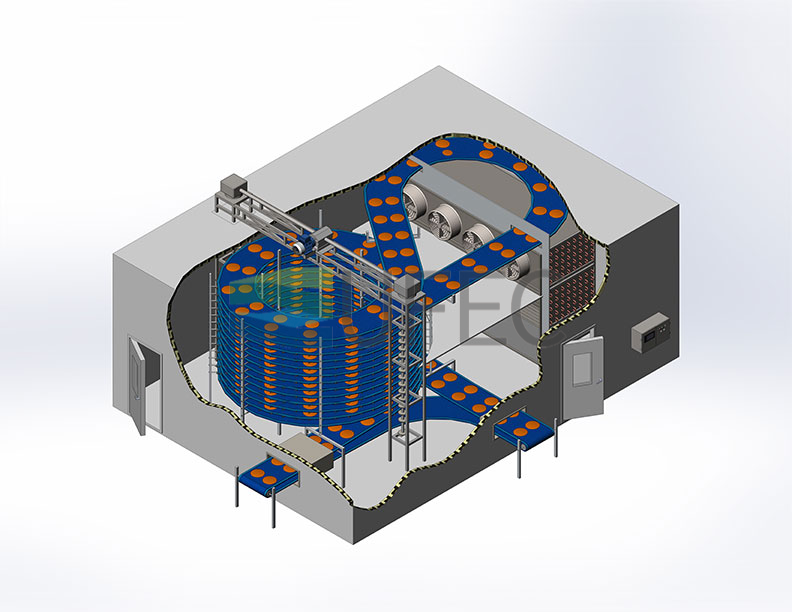
At its core, an industrial spiral cooling tower is a highly engineered, continuous conveyor belt system designed to maximize retention time within a minimal footprint. A modular conveyor belt wraps around a rotating central cylindrical drum. As the drum turns, it smoothly drives the belt, moving food products upward or downward in a continuous helical pattern.
Let us look at the engineering parameters. High-performance models feature customizable belt widths, typically ranging from 400 millimeters to 1200 millimeters, accommodating varying production volumes. The framework utilizes robust 304 or 316 stainless steel. Belts are often crafted from food-grade Polyoxymethylene, known as POM, ensuring high tensile strength and low friction. Tier pitch is meticulously calculated based on your maximum product height to optimize airflow.
| Feature | Traditional Linear Conveyor | Industrial Spiral Cooling Tower |
|---|---|---|
| Footprint | Requires massive horizontal floor space. | Saves up to 80% of floor space by utilizing vertical height. |
| Dwell Time Control | Fixed by line length; hard to adjust. | Highly adjustable via variable frequency drives. |
| Product Transfer | Multiple transfer points risk product damage. | Continuous belt minimizes mechanical stress on fragile goods. |
| Sanitation | Difficult to enclose and automate cleaning. | Ready for automated Clean-In-Place integration. |
Plant engineers typically choose between two thermal management approaches based on product perishability. Ambient spiral coolers are open-frame structures. They utilize the surrounding room-temperature factory air to naturally draw heat away from baked goods. This method is highly energy-efficient and serves as the standard choice for traditional breads and bagels.
In contrast, forced-air or chilled spiral cooling towers are enclosed within insulated panels. These systems integrate with heavy-duty refrigeration units to rapidly circulate chilled air across the product. Forced-air systems are essential for highly perishable items, raw dough requiring rapid freezing, or facilities operating in notoriously hot and humid climates.
The bakery sector is currently undergoing a massive operational shift. Rising industrial real estate costs force manufacturers to maximize existing square footage. Expanding outward is rarely viable in modern urban centers. Consequently, vertical space utilization is no longer a luxury; it is a baseline engineering requirement.
Furthermore, stringent energy regulations and sustainability goals are pushing facilities toward smarter thermal management. We are seeing a distinct trend where bakeries favor enclosed, climate-controlled chilling systems over traditional open-air cooling. This shift ensures precise temperature drops regardless of external weather conditions, drastically reducing product waste and improving overall energy efficiency.
Uniformity is king in the fast-food supply chain. Hamburger buns must maintain a perfectly uniform shape to fit standardized preparation equipment. Rapid, uniform cooling in a vertical tower stabilizes the gluten structure. This crucial step prevents the bread from collapsing under its own weight and ensures the crumb is firm enough to withstand high-speed hinge slicing.
Producing dense artisanal breads and bagels presents a unique thermal challenge. These items possess a high moisture content and a dense dough structure. They retain latent heat significantly longer than lighter pastries. Industrial towers designed for heavy-duty applications utilize reinforced plastic modules or stainless steel mesh belts capable of supporting substantial weight. The extended vertical tiers provide the necessary 45 to 60 minutes of retention time required for heavy products.
Softer baked goods with high fat and sugar contents demand a much gentler touch. They are highly susceptible to structural damage, deformation, and surface smearing if subjected to jerky movements. Utilizing a spiral cooling conveyor ensures fragile items glide through the cooling phase. Features like ultra-smooth belt surfaces and seamless transfer plates protect delicate items from losing their aesthetic appeal.
Modern bakeries are increasingly prioritizing smart automation to maintain profit margins amid labor shortages. Today's advanced cooling systems act as highly intelligent data-generating hubs. Integrated sensor arrays continuously track critical data points in real-time. This includes belt tension, motor torque, ambient humidity, and tier-by-tier temperature gradients.
This data feeds into a centralized control panel, providing plant managers with a comprehensive overview of the cooling process. This guarantees that environmental conditions within the tower remain perfectly calibrated for the specific product recipe.
Unplanned downtime in a continuous baking operation is catastrophic. It results in thousands of dollars of ruined, uncooled product backing up on the line. Predictive analytics transforms facility maintenance from a reactive scramble into a proactive strategy.
Predictive software analyzes historical data and real-time inputs to identify micro-anomalies weeks before a failure occurs. Facility managers receive automated alerts indicating exactly which bearing needs lubrication or which wear strip requires replacement. This allows maintenance crews to schedule targeted repairs during planned sanitation windows.
Procuring the right equipment requires rigorous mathematical calculation. Plant engineers must evaluate their target throughput, usually measured in kilograms per hour. You must also measure the physical dimensions of the largest product and determine the required cooling dwell time. These critical metrics dictate the necessary belt width, the vertical spacing between tiers, and the total length of the belt required to achieve desired cooling.
The physical layout of the factory floor dictates the logical flow of goods. Engineers must map the journey from the oven exit to the packaging line. Buyers must choose between an ascending up-drum or descending down-drum system.
An up-drum configuration accepts hot product at the bottom tier and spirals upward, exiting near the ceiling. This is ideal if the packaging line is located on a mezzanine. Conversely, a down-drum configuration takes product from an elevated oven, spiraling downward to deliver cooled goods to ground-level slicing and bagging machines.
Conveyor belt material directly influences thermal transfer and maintenance schedules. Food-grade POM plastic modular belts are lightweight, offer low friction, and prevent sticky products from adhering to the surface. Stainless steel mesh belts are preferred for extremely heavy loads or environments where the product enters the cooler at exceptionally high temperatures.
Manual sanitation of a massive vertical conveyor is notoriously labor-intensive. To optimize this daily chore, modern systems are frequently equipped with Clean-In-Place technology. This system integrates automated spray nozzles, foaming stations, and air-drying blowers directly into the tower framework.
During a cleaning cycle, the belt runs continuously while the system automatically applies hot water, food-safe detergents, and sanitizers. This automated protocol drastically reduces manual labor hours, minimizes water usage, and ensures consistent compliance with stringent sanitation requirements.
The human element remains vital for mechanical longevity. Maintenance crews must establish a routine schedule to monitor critical wear points. Key inspection tasks include lubricating the main drive chain and inspecting the ultra-high-molecular-weight polyethylene wear strips for excessive friction degradation. Measuring the belt for signs of elongation and ensuring the central drum remains perfectly aligned will prevent premature wear.
A spiral cooling tower is far more than just a conveyor belt. It is a strategic logistical investment. Taking operations vertical decisively resolves floor space bottlenecks, boosts overall production capacity, and ensures consistent product quality batch after batch. Flexible and efficient operations are the ultimate keys to long-term profitability in the highly competitive commercial bakery industry.
If your facility is struggling with limited space or inconsistent cooling, it is time to upgrade your production lines. Explore custom, high-efficiency industrial spiral cooling towers to find the perfect engineering fit for your facility demands, and watch your operational efficiency soar.
By utilizing vertical airspace, a spiral tower can pack hundreds of feet of conveyor belt into a footprint as small as 15 by 15 feet. This vertical engineering saves up to 80% of the horizontal floor space that would otherwise be required by a traditional linear cooling line. This frees up valuable room for additional ovens or packaging equipment.
Yes. Modern systems feature variable frequency drives, allowing operators to digitally adjust the speed of the belt. A bakery can cool quick items like donuts on a fast cycle, and then slow the belt down to provide the extended dwell time required for dense items like heavy artisan bread loaves.
While it depends heavily on the specific recipe, ambient temperature, and loaf size, standard commercial bread typically requires 45 to 60 minutes to cool from an internal temperature of 200 degrees Fahrenheit down to 90 degrees Fahrenheit. Reaching 90 degrees Fahrenheit is critical, as it is the globally recognized safe temperature for slicing and bagging without causing internal condensation.
They are not difficult to clean if designed correctly. High-quality industrial towers feature open-hinge modular belts, sloped structural surfaces for proper water drainage, and automated Clean-In-Place systems. These integrated features make daily sanitization fast, highly effective, and far less reliant on manual scrubbing.
Ambient towers use the surrounding factory air to naturally cool baked goods over time, which is highly energy-efficient. Chilled towers are fully enclosed in insulated panels and utilize active refrigeration units to rapidly drop the temperature. Chilled systems are typically reserved for freezing raw dough or cooling highly perishable items that require strict temperature controls.
Load capacity varies based on belt width and material selection. Heavy-duty stainless steel mesh belts or reinforced POM plastic belts can handle dense products like panned bread or heavy bagels, often supporting upwards of 50 to 100 kilograms per linear meter without structural deformation.
Absolutely. Custom spiral towers are specifically designed for retrofitting. Engineers tailor the infeed and outfeed elevations, belt speeds, and layout configurations to seamlessly connect with your current ovens and downstream packaging equipment, ensuring a smooth operational flow.
