
Views: 0 Author: Site Editor Publish Time: 2026-11-24 Origin: Site


Are rising energy costs and inconsistent product quality hurting your food processing margins? Balancing high-volume production with strict quality control is the ultimate challenge on the factory floor. Batch ovens often cause uneven cooking. This leads to wasted raw materials, frequent quality assurance rejections, and shrinking profits.
Transitioning to continuous thermal heating systems represents a monumental shift for industrial food manufacturing. Implementing continuous thermal heating in a Cooking Spiral Oven maximizes valuable floor space. It also dramatically improves product yield. This advanced technology ensures unmatched temperature consistency. It turns eco-friendly sustainability into long-term profitability for processing pork, chicken, steak, and fish.
Recent market analyses highlight a definitive transition in commercial food processing. Facilities are rapidly abandoning legacy batch systems. Why? The driving forces are volatile global energy prices and stringent environmental regulations. Plant managers now prioritize smart thermal management solutions. These modern systems focus on heat recovery and carbon footprint reduction.
Furthermore, the push for automation demands equipment that minimizes human intervention. Continuous systems perfectly align with these industry trajectories. They prove that operational efficiency directly drives business profitability.
Evaluating industrial cooking equipment requires a solid grasp of thermodynamic mechanics. Recognizing how continuous systems differ from traditional batch processing is the foundational step toward operational efficiency.
Continuous thermal heating maintains a steady, uninterrupted transfer of heat. Food products move continuously along a conveyor system. Traditional batch cooking forces operators to frequently open and close heavy oven doors. This breaks the thermal seal. Ambient air rushes in, causing the internal temperature to drop rapidly. The oven then consumes massive amounts of energy to reheat the chamber.
In contrast, continuous thermal heating entirely eliminates this cycle. It provides a stable microclimate. This ensures exact thermal application from the moment the product enters the chamber until it safely exits.
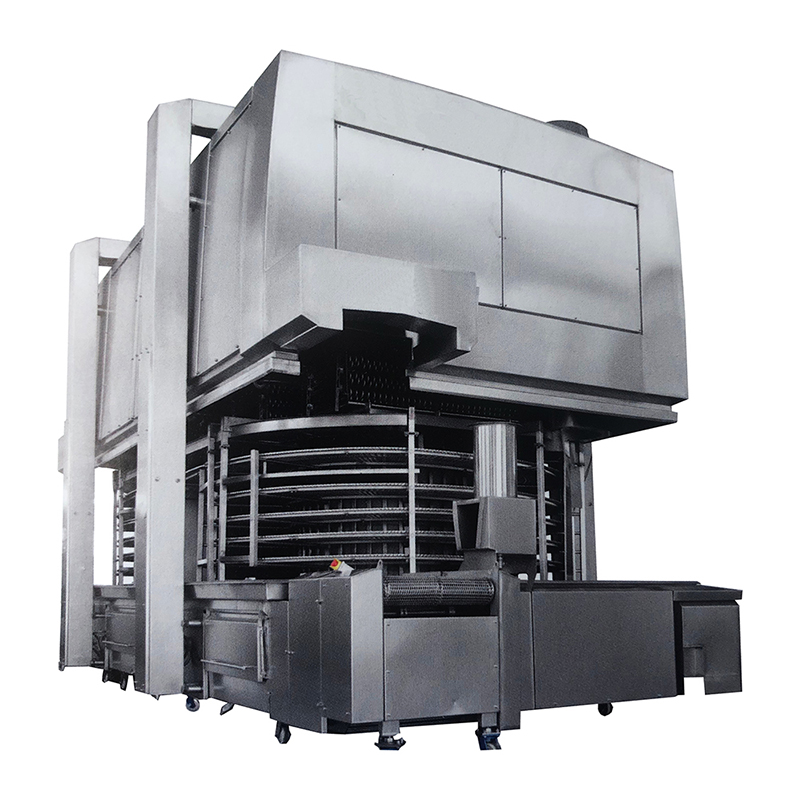
At the core of this technology is a multi-tier conveyor belt system. Instead of moving products in a straight line over a long distance, the belt travels upward or downward in a continuous spiral configuration.
Inside the heavily insulated enclosure, the oven integrates hot air convection and direct steam injection. High-velocity fans distribute heat evenly across every tier. The continuous movement ensures the food is exposed to the exact same temperature and humidity profiles for a highly specific duration. The result is a predictable and repeatable cooking process.
Uneven cooking is a massive pain point in large-scale food manufacturing. This operational headache almost always stems from poor airflow management within the heating chamber.
Older industrial ovens frequently suffer from chaotic airflow. Air currents bounce unpredictably off walls, metal racks, and the food itself. This turbulent environment leads to rapid heat loss in certain areas. Distinct cold spots form. Products near the heating elements burn. Meanwhile, those near the doors remain dangerously undercooked. This inconsistency leads to high rejection rates and potential food safety compliance issues.
Continuous systems resolve this issue utilizing targeted, directional airflow. Advanced industrial spiral ovens use precisely engineered baffles and variable-speed fans. These components guide hot air and steam in a uniform pattern across the spiraling belt.
Specifically, this directional airflow ensures the thermal transfer is identical across the entire width and height of the conveyor. A piece of chicken on the outermost edge receives the exact same thermal treatment as one in the center. This precision guarantees unmatched consistency for every single batch.
In the competitive protein processing industry, profit margins are directly tied to product yield. Moisture loss during cooking means evaporating profits right off the factory floor.
Subjecting proteins to dry, uncontrolled heat causes muscle fibers to contract aggressively. They squeeze out water and fat. This harsh environment can lead to a weight loss of up to 25 percent in traditional roasting scenarios.
Utilizing a sophisticated combination of hot air and steam changes the equation. The introduction of steam increases humidity inside the cooking chamber. This drastically slows down the rate of moisture evaporation. Retaining internal moisture translates directly to a higher final product weight. For a facility processing thousands of pounds of meat daily, even a minor improvement in moisture retention results in massive added revenue annually.
Continuous thermal heating also dramatically improves culinary quality. The highly controlled environment helps processors achieve the perfect Maillard reaction. Heat is applied evenly while internal moisture is protected by ambient steam. The exterior of a steak achieves an ideal roasted color. The interior remains exceptionally tender and juicy.
To truly understand the operational upgrade, facility managers must evaluate the core engineering metrics across different heating systems.
| System Type | Footprint Efficiency | Yield Retention | Energy Consumption | Automation Level |
|---|---|---|---|---|
| Traditional Batch Oven | Low | Poor | High | Manual Loading |
| Linear Tunnel Oven | Very Poor | Moderate | Moderate | Fully Automated |
| Continuous Spiral Oven | Excellent | Superior | Low | Fully Automated |
Floor space in a commercial plant is a premium asset. Expanding a facility's physical footprint involves massive capital investment and crippling construction downtime.
Traditional linear tunnel ovens require a massive amount of floor space. They must be extremely long to ensure the product remains in the heat zone for the required time. Spiral designs completely flip this paradigm. By stacking the conveyor belt in a multi-tier spiral, these ovens condense the cooking zone into a compact cubic footprint. You can replace a 60-foot linear tunnel oven while occupying only a fraction of the area.
This vertical design is a strategic advantage for growing businesses. Facility managers can double or triple production output within the exact same building. This completely avoids the need to relocate to larger, more expensive premises.
Upgrading industrial cooking equipment must align directly with long-term processing goals. How do you select the right system? Look at the hard engineering parameters.
When evaluating options, consider the specifications of a high-performance Hot Air Steam Cooking Spiral Oven. True industrial-grade equipment features independent dual-zone temperature control. This allows operators to set different climates for the ascending and descending spirals. Look for systems constructed entirely from fully welded SUS304 stainless steel to eliminate bacterial harborage points.
Direct steam injection capabilities are non-negotiable for processing pork, chicken, steak, and fish. The system must precisely manipulate both dry-bulb and wet-bulb temperatures. If your current equipment lacks these specific parameter controls, you are losing money on yield and energy inefficiency.
Procuring an advanced thermal processing system is only the first step. Facility operators must implement rigorous daily best practices to maximize ROI.
Achieving the perfect balance between retention time and thermal settings is essential. Operators must carefully calibrate the ratio of hot air velocity to steam injection.
Processing thick steaks requires a slower belt speed and higher steam injection. This ensures the core temperature is reached without drying out the meat. Conversely, thin chicken strips require higher air velocity and lower humidity for a crispy finish. Documenting these specific recipe parameters guarantees batch-to-batch consistency.
Modern systems feature hygienic design principles with sloped floors for rapid drainage. Facilities must fully utilize automated Clean-in-Place systems. A standard protocol involves a high-pressure pre-rinse, a caustic chemical wash, a secondary rinse, and a final sanitization cycle.
Preventative mechanical maintenance is equally crucial. Regularly inspecting belt tension and monitoring steam injection valves ensures peak thermal efficiency and prevents catastrophic line downtime.
Continuous thermal heating systems provide reliable, high-performance solutions for modern food processing facilities. Moving away from the chaotic airflow of traditional batch ovens ensures unprecedented temperature consistency and operational stability.
Upgrading your equipment directly improves product yield. It locks in vital moisture for high-value proteins while reducing energy consumption. The vertical design saves valuable floor space, allowing commercial plants to scale output without costly facility expansions.
Investing in a high-quality Double Spiral Steam Oven is a strategic business move. It secures long-term profitability and product superiority. If your facility is ready to optimize yield and reduce energy waste, visit UFEC Tech today. Explore their advanced equipment range to find the exact continuous thermal solution that matches your production line needs.
These systems excel at cooking proteins that require strict moisture retention and precise core temperature control. They are heavily utilized in the industrial processing of pork, chicken, steak, and fish. The controlled microclimate prevents the dehydration of muscle fibers. Additionally, the uniform heat distribution makes these systems highly effective for processing baked goods and formed plant-based protein products.
Continuous thermal heating maintains a steady internal environment relying on thermodynamic stability. Traditional batch ovens suffer from massive heat loss every time their doors are opened. Continuous spiral systems utilize heavy insulation, targeted directional airflow, and enclosed entry baffles to minimize thermal escape. This results in significantly lower overall energy consumption per kilogram of processed food.
Yes. The most advanced industrial models operate as hybrid systems integrating both hot air convection and direct steam injection. This dual-capability allows processors to precisely manipulate both the ambient heat and the humidity. By controlling the dew point within the oven chamber, processors can execute complex cooking profiles.
No. Modern industrial spiral ovens are specifically engineered to exceed strict global hygiene standards. They eliminate complex manual scrubbing by utilizing automated Clean-in-Place systems. These integrated systems use strategically placed rotating spray nozzles to automatically wash, degrease, sanitize, and dry the continuous belts and interior chamber.
The spatial efficiency of a spiral design is a primary operational advantage. Depending on your required production volume, a vertical system can save between 50 and 75 percent of the linear floor space required by a traditional tunnel oven with the exact same output capacity.
Retention time is highly variable and fully adjustable based on the product. Driven by variable frequency drives, the belt speed can be calibrated to provide retention times ranging from a few minutes for thin poultry strips to over an hour for dense, bone-in pork roasts. This flexibility is key to multi-product processing lines.
A single spiral oven features one continuous belt path, typically entering at the bottom and exiting at the top. A double spiral oven utilizes two interconnected spiral drums. The belt ascends on the first drum and descends on the second. This design dramatically increases the total belt length and cooking time within the same compact footprint. It also allows for distinct dual-zone temperature control between the two drums.
